

Season 5 - Concert No. 1
The Joy of Circuses & Feats of Daring Do
September 25 & 26, 2026
PROGRAM NOTES
First Half:
Step right up! Step right up! Ladies and gentlemen, children of all ages—step right up and prepare for the main event as the amazing CACO Clarinet Quartet sets the stage while you take your seats!
Julius Fučík composed his Grand Marche Chromatique in 1897 with the original subtitle Triumph-Marsch. This grand military march showcased the absolute apex of contemporary brass and woodwind instrument design, which allowed performers to play chromatically with unprecedented speed—our first feat of daring-do! After reading about the entry of the gladiators into the Colosseum in Henryk Sienkiewicz’s novel Quo Vadis, Fučík retitled the piece Entry of the Gladiators (our second feat of daring-do). Later arranged for string orchestra, grand orchestra, and full concert band over the years, it was Canadian composer Louis-Philippe Laurendeau’s arrangement—titled Thunder and Blazes—that cemented the work's fame in North America as the definitive circus "screamer" used to introduce the clowns.
Paule Charlotte Marie Jeanne Maurice, an exceptional French composer of the early twentieth century, wrote her most famous work for the renowned virtuoso saxophonist Marcel Mule. While usually performed with piano reduction, it is heard today in its full orchestral glory. Our own virtuoso saxophonist, Ian Warwick, performs Tableaux de Provence (our third feat of daring-do for those keeping score!). Despite her relatively short life—she passed away at age 56—Maurice was the recipient of numerous prestigious honors, including the Prix Helpheu, Prix du Congrès Marial de Boulogne, Prix Pasdeloup, and the Prix Georges Hüe (bringing us to four feats of musical daring-do).
Tableaux de Provence consists of five miniature musical portraits depicting countryside life in southeastern France. With their vivid textures and theatrical flare, these movements could easily serve as the soundtrack to a modern Cirque du Soleil production:
-
Farandoulo di chatouno / Farandole des jeunes filles (Farandole of the Young Girls)
-
Cansoun per ma mio / Chanson pour ma mie (Song for My Love)
-
La boumiano / La bohémienne (The Bohemian Woman / The Gypsy)
-
Dis alyscamps l'amo souspire / Des Alyscamps l'âme soupire (A Sigh from the Soul for the Alyscamps)
-
Lou cabridan / Le cabridan (The Southern Hornet)
Circus Renz was a legendary family-owned German circus company based in Berlin, originally founded as Circus Olympique. Although the original company closed in 1897, the Renz family name remains active across European circuses to this day. No if you’ll direct your attention to ring no 3, our virtuosic percussion section will amaze and delight you with Gustav Peters’ Memory of Circus Renz—a feat of daring xylophone-do!
In ring number 1, closing the first half of our concert, Henry Fillmore’s The Circus Bee is a high-octane circus march named after a fictitious circus newspaper and inspired by Fillmore's own colorful youth traveling with five different circus shows as a trombonist. Today, we strip the march down to its bare essentials: an exposed, high-wire brass trio arrangement by Maestro James Bicigo. Listen as Karen Gustafson (trumpet) carries the melody, Louise McMurray (horn) weaves the countermelody, and James Bicigo (trombone) anchors the bass line in a thrilling tightrope act of ensemble performance.
Intermission
Now for our next act in the center ring, we must ask for your absolute silence and concentration—our orchestra is taming wild beasts in an awesome feat of animal training! Mark Janza’s The Lion Tamer Rag will delight you as your imagination soars with the antics of not one, not two, not three, but four lions in this syncopated fantasia.
Draw your attention back to ring number one, everybody! See our woodwind quintet preparing for their performance of Timothy Lee’s Circus Minimus. Join in the circus parade, see if the sleepy clowns will entertain us, and hop on the circus carousel for some more ragtime music. Let your imagination take you on a stroll through the main carnival outside the big top, enjoying cotton candy, peanuts, and popcorn.
Oh, look everyone—I think Popeye must have joined our woodwind quintet, because they are getting ready to perform The Sailor’s Hornpipe! Listen as they perform feats of musical strength and agility that will leave you in awe of their virtuosity.
Now, what would a circus be without our friends the elephants? If you draw your attention back to the center ring, the CACO presents Henry Mancini’s classic hit, Baby Elephant Walk. Written for the film Hatari!, the music depicts mother elephants leading their young to the water hole. Listen for the playful interruptions in the music as the mothers try to guide their rambunctious babies to their bath!
In North America, the Ringling Bros. and Barnum & Bailey Circus was the ultimate merger of the three largest traveling circuses of the late 19th and early 20th centuries. The 2017 film The Greatest Showman tells the romantic and fantastical story of P.T. Barnum, who built his novelty show into a full-blown circus spectacle. Here in the center ring, CACO plays the hit song from that movie, A Million Dreams.
Ladies and gentlemen, children of all ages, we hope you have enjoyed our celebration of circuses and feats of daring-do! Be sure to thank our Spotlight Sponsor, Alternative Landscape Solutions, as well as the City of Red Deer and our many other sponsors for their vital support in bringing live orchestral chamber music to Central Alberta. We send you off today with one of the greatest circus screamers of all time: Karl King’s Barnum & Bailey’s Favorite March!


Season 4 - Performance 3
The Winds of March
Winds of March: Program Notes
Overture in C for Harmoniemusik
Felix Mendelssohn (1809–1847)
Mendelssohn’s Overture in C is a cornerstone of early wind repertoire, rooted in the composer’s youth. During summer trips to the seaside resort of Bad Doberan, a teenage Mendelssohn was captivated by the local wind bands performing in the park. Inspired, he composed a one-movement work titled Notturno. Years later, he re-titled the piece
and expanded the orchestration for a standard military band, adding percussion and additional measures. The version CACO performs today is a unique hybrid: it retains the transparency of the original instrumentation but incorporates modern saxophone and percussion, all while utilizing Mendelssohn’s original, more concise ending.
Concertino in E-flat Major, Op. 26
Carl Maria von Weber (1786–1826)
Completed in an astonishing three days (March 29 – April 3, 1811), this Concertinowas written for the virtuoso clarinetist Heinrich Bärmann. Bärmann mastered the piece in just 72 hours, performing it for King Maximilian I of Bavaria. The King was so moved that he reportedly purchased 50 tickets for the performance and immediately commissioned Weber to write two full-length concertos. The CACO is proud to feature our own Diana Bushell as soloist for this virtuosic work.
Trauersinfonie (Funeral Symphony)
Richard Wagner (1813–1883)
Composed for an 1844 solemn procession, this work honored the repatriation of Carl Maria von Weber’s remains from London to Dresden. As a tribute to his predecessor, and father in law Wagner based the work on themes from Weber’s opera Euryanthe, specifically melodies associated with the spirit of the deceased. Originally scored for a massive outdoor wind band of nearly 80 players, Wagner later added string parts for indoor performances. Today’s performance features a hybrid arrangement specifically tailored to the intimate and varied textures of a chamber orchestra.
Wind Quintet No 1, Op 54
Franz Danzi (1763–1826)
A contemporary of Beethoven and a mentor to Weber, Danzi was a
devoted admirer of Mozart’s style. Though he composed operas and symphonies, he is best remembered today for his wind quintets. We present three movements that showcase his evolution from Classicism to Romanticism:
• I. Allegro: A textbook example of sonata form, echoing the
elegance of Anton Reicha.• II. Andante con moto: A movement
hinting at the emerging Romantic lyricism later perfected by
Schubert.
• III. Menuetto & Trio: A traditional minuet paired with a Trio in the
style of a Ländler (a rustic folk dance).
Eine kleine Nachtmusik, K. 525 (I. Allegro)
Wolfgang Amadeus Mozart (1756–1791)
Perhaps the definitive example of the Classical style, this "Little Night Music" embodies the era’s ideals of balance and clarity. While Mozart’s records suggest he originally wrote five movements, only four survive. In the 18th century, individual movements were often performed as "party music" for social gatherings. Today, CACO presents the iconic first movement in an arrangement for salon orchestra by Franz Willms.
Dream’s Edge Revisited
Tim Brehaut (b. 1978)
In 2006, CACO’s own Tim Brehaut composed Dream’s Edge for his
wedding to Allison Weir. To celebrate their 20th anniversary, he has reimagined the work for chamber orchestra. This concert cycle marks the world premiere of this new composition, Dream’s Edge Revisited.
Florentiner March (Grand Marche Italienne)
Julius Fučík (1872–1916)
Known as the "Bohemian Sousa," Fučík was a prolific Czech composer whose Florentiner March is beloved for its operatic flourishes and heroic fanfares. While 19th-century marches were typically the domain of military bands, it was common to add string parts for symphonic settings. Today’s performance follows that historical tradition, integrating strings into the bold, rhythmic structure of this classic march


Season 4 - Performance 2
Holiday Stories


Season 4 - Performance 1
Classically Yours


Season 3 - Performance 4
CACO Goes to the Movies

Season 3 - Performance 3
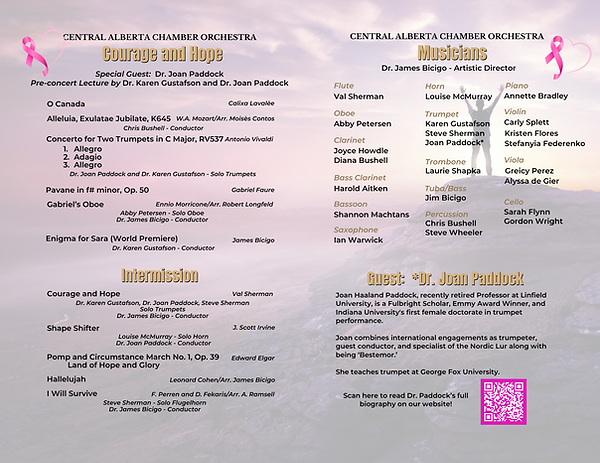
Courage and Hope
Season 3 - Performance 2
Rudolph Meets Holiday Tradition



Season 3 - Performance 1
Mountain Music


Main Series #2
Country AND Westerns


